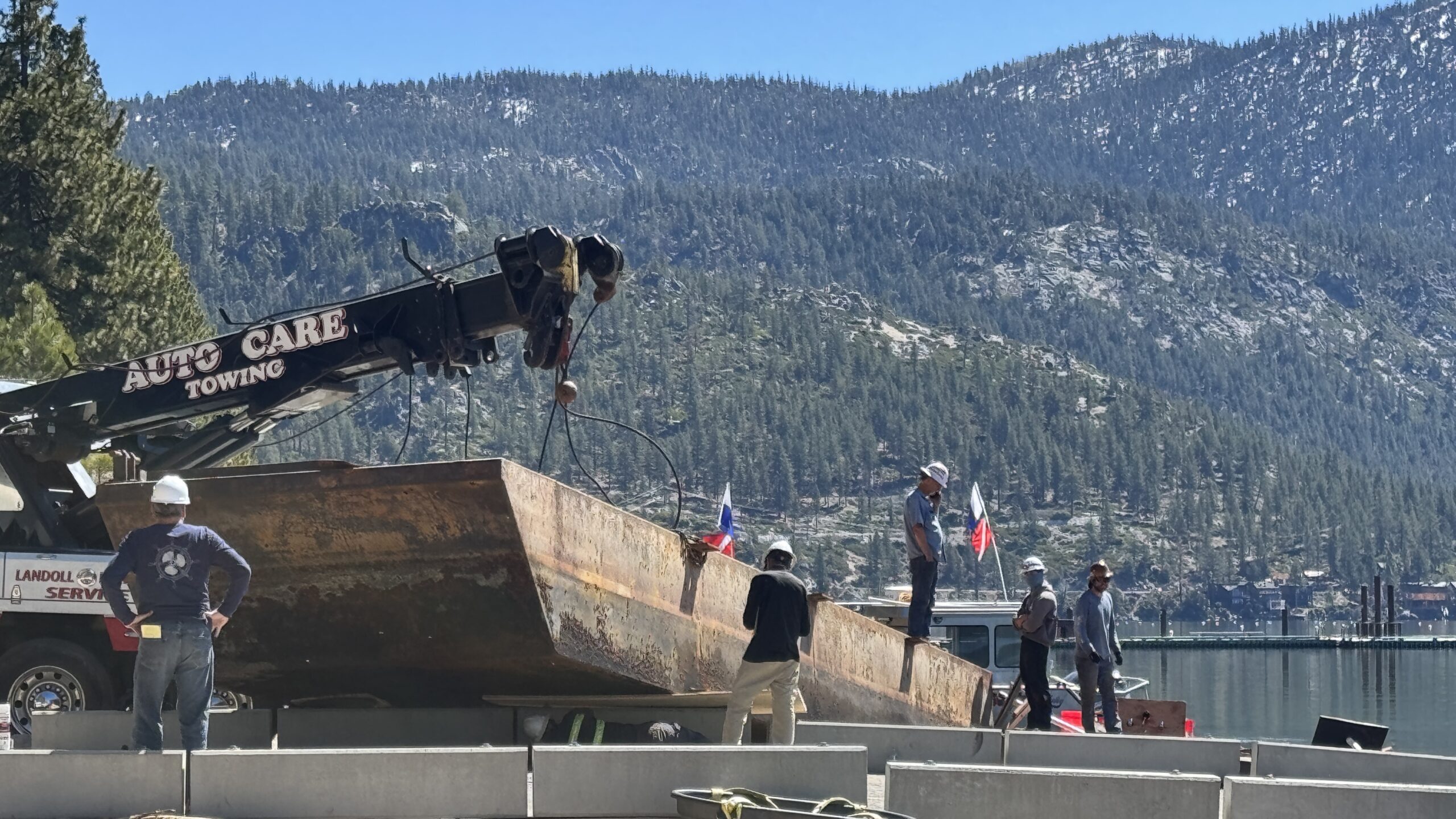
Recovery efforts are now actively underway to remove the sunken fireworks barge from the waters offshore of Ski Beach in Incline Village. This highly technical and physically demanding salvage operation began on March 16, 2026.
Dive teams, marine crews, and agency partners are working in close coordination to locate, secure, and begin extracting debris from the lakebed, with some materials resting at depths approaching 160 feet.
From the outset, the work has been methodical. Each day begins with planning and safety briefings involving multiple agencies, followed by carefully staged operations on the water. A remotely operated vehicle, or ROV, was first deployed to locate the barge and establish precise working zones. Divers then began descending along secured lines to recover debris and assess conditions on the lakebed.
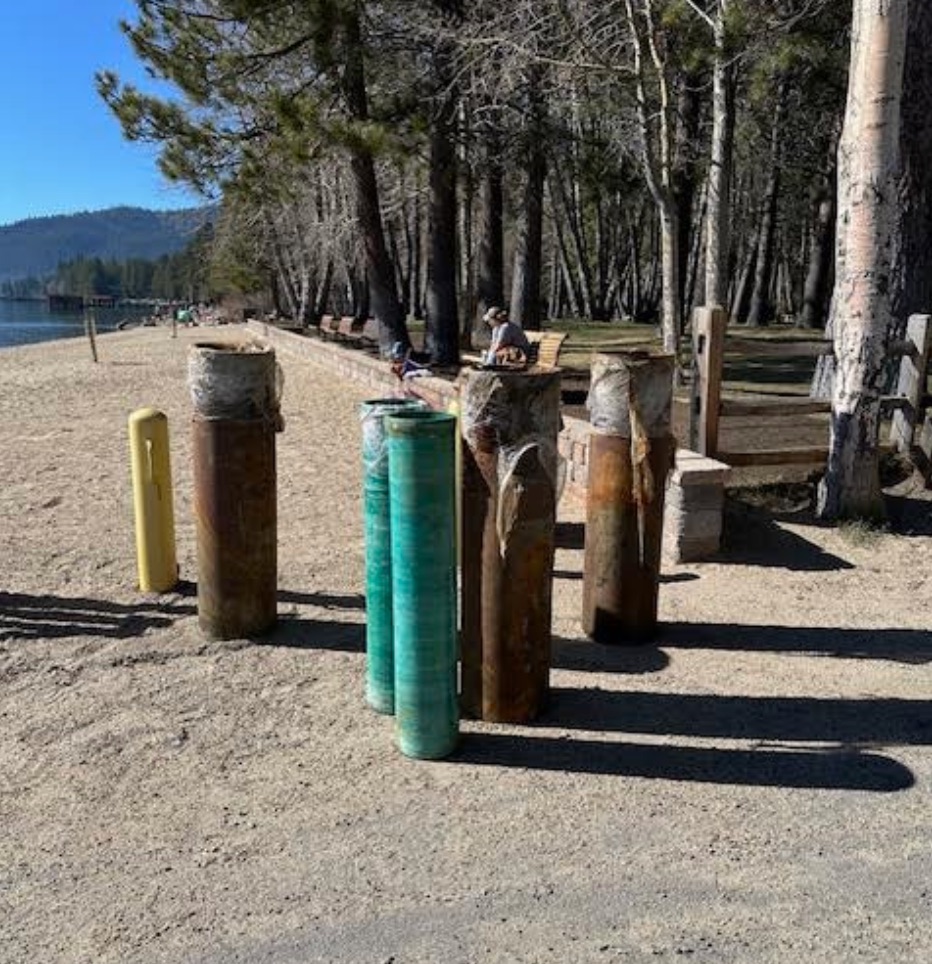
Progress is steady, but intentionally cautious. At depth, visibility quickly drops to near zero once sediment is disturbed, requiring divers to rely on training and touch to locate and rig debris. Many of the materials, particularly large firework tubes, are heavy and irregularly shaped, often requiring multiple dives to secure a single piece.
These are short, highly controlled dives, sometimes limited to 10 minutes, and they demand both physical endurance and precision.
Crews have already recovered a range of debris, including firework components, with additional materials identified for retrieval.
As work has progressed, logistical challenges have become more apparent. Sonar mapping revealed a steep underwater shelf along the planned recovery path, where the lakebed drops sharply from approximately 80 feet to over 150 feet within a short distance. This requires careful repositioning of the barge during extraction to prevent instability.
To prepare for lifting operations, teams have installed a network of heavy-duty lines, known as hawsers, along with lift bags designed to gradually raise the structure. By March 18, four of six primary lift lines had been set, with additional rigging completed shortly after.
As expected with a project of this scale, there have been setbacks. Mechanical issues, including a seized air compressor and engine challenges, caused temporary delays earlier in the week, but both have since been resolved.
On March 20th, crews reached an important milestone when the barge began to lift, rising approximately 40 feet off the lakebed before two primary lines failed under pressure. The release sent several lift bags rapidly to the surface.
No divers were in the water at the time, and established safety protocols ensured there were no injuries.
Following the incident, crews determined that uneven air distribution, caused by a kinked airline, placed excessive strain on certain lines. The team is now replacing the original 1.5-inch lines with heavier 2-inch hawsers and upgrading air systems to ensure a more balanced lift.
While much of the work is taking place offshore, public activity has added another layer of complexity.
Despite clearly marked safety zones, some boaters, paddleboarders, and kayakers have approached or entered restricted areas. Even when outside the perimeter, fast-moving boats can create wakes that disrupt sensitive equipment and temporarily halt operations.
Onshore, IVGID staff and park ambassadors have played an important role in maintaining the beach closure and preventing unauthorized access. Additional signage and coordination with the U.S. Coast Guard and TRPA continue to reinforce the need to stay clear of the work zone.
Crews have also noted concerns with exposed lift bags, some visible at the surface and others just below. These can pose a safety risk if approached or disturbed.
This is not a routine recovery effort. Divers are working in deep, cold water with limited visibility while managing heavy materials and complex rigging systems. Every step is calculated, and safety remains the top priority.
Weather conditions also continue to influence the timeline, with wind already causing periodic pauses in operations. Teams are monitoring conditions closely and adjusting plans as needed.
The immediate focus remains on safely lifting and repositioning the barge so it can be brought to shore. While the process may appear slow, it is progressing as intended, with careful attention to safety and detail at every stage.
The community’s continued patience and cooperation is both noticed and appreciated.
Photos of the operations provided by Parker Diving Service